
Three products. One perimeter. Nothing leaves.
EventHorizon watches and automates the network. EventResolve works the tickets that fall out of it. EventConnect governs who can reach the infrastructure. All three run on your hardware, as a load-balanced cluster that scales out and fails over without anyone noticing.
What leaves your perimeter?
| Data category | Typical hosted SaaS NMS | EventSuite |
|---|---|---|
| Alarms, logs, and trap streams | Leaves your network Ingested by the vendor's cloud for correlation and AI analysis. |
0 bytes leave Processed on-premises; AI runs on hardware you own. |
| Flow records (who talks to whom) | Leaves your network Exported to the vendor's cloud for top-talker and security analytics. |
0 bytes leave Spoofing and port-scan detection run locally; exports stay on your disk. |
| Inventory, CMDB, and IPAM records | Leaves your network Synchronized to the vendor's multi-tenant database. |
0 bytes leave Single on-premises datastore; no external sync. |
| Ticket bodies and customer PII | Depends on vendor Summarization features typically call external AI services — at per-use prices. |
0 bytes leave Summaries and drafts are generated on your own hardware, at no per-use cost. |
| AI usage | Leaves your network Prompts and context sent to third-party AI endpoints — billed per use. |
0 bytes leave AI runs on your own hardware — predictable cost, no meter running. |
| Privileged access & session data | Separate PAM product Another license to buy; standing keys and passwords; session data often synced to a vendor cloud. |
Included in the suite EventConnect grants short-lived access on demand; recordings stay with you. |
| Deployment topology | Vendor-hosted Requires persistent outbound connectivity — and ongoing subscription fees. |
Air-gap deployable No internet dependency; everything you need is bundled in the install. |
Three products, one closed loop.
Investigation with memory
Semantic search over historic incidents. The AI recalls similar past alarms and how they were resolved — "3 similar incidents last year, each an SFP failure, avg. time-to-clear 6 hours."
EventHorizon · AIOpsFindings become tickets
When EventHorizon isolates a fault, the finding goes to EventResolve as a ticket with its evidence attached. Closed-loop automation — no copy-paste, no swivel-chair.
01 → 02 · Closed-loopWho connects is a policy decision
EventConnect grants short-lived, per-person access to servers, databases, and applications — with approvals, session recording, and a tamper-proof audit trail. Shared passwords and forgotten keys disappear.
03 · EventConnect · Zero trustEach product is separately installable and shares no runtime dependency on the others — adopt one, two, or all three.
Agentic AI you host. A platform you run.
The two things people assume you have to give up to get self-hosting: capable AI, and operational simplicity. You don't.
AI that stays inside your perimeter
Agentic AI runs on your own infrastructure. No cloud, no external API calls, no per-token bills. The assistants investigate and draft on their own — your team approves the actions.
All three products · Agentic AIOne platform, one license
Replace a patchwork of monitoring, ticketing, and access tools — each with its own license, servers, and maintenance contract — with one suite. Fewer vendors, fewer renewals, lower total cost of ownership.
Cost savings · Lower TCOBuilt to scale out
Add nodes for capacity and resilience. No extra services to buy or babysit.
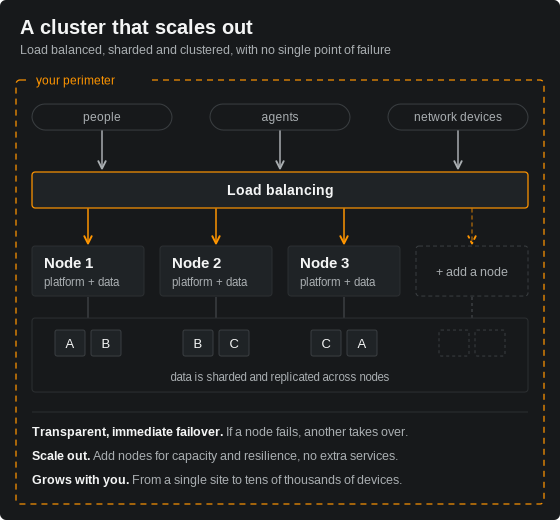
Load balanced across every node
Requests from people, agents, and network devices are spread across all nodes in the cluster, so no single server becomes the bottleneck.
Cluster · Load balancingSharded, replicated data
Data is split into shards and replicated across nodes, so storage and query load grow with the cluster — and no node holds the only copy of anything.
Datastore · Sharding, replicationTransparent, immediate failover
If a node goes down, another takes over transparently and immediately. Nobody has to intervene, and there is no single point of failure anywhere in the stack.
Resilience · FailoverScale out, not up
Start with a single site and add nodes as you grow — from one node to 5,000+ devices without re-architecting. The platform plus its database is the whole deployment; no extra services to buy or babysit.
Capacity · Horizontal scalingNothing leaves your perimeter unless you decide it should.
Download and start using.
Self-hosted, air-gap deployable, and running on your own hardware in under an hour.