From Horizon
to Resolution.
EventHorizon unifies assurance, automation, and inventory on your own infrastructure. EventResolve turns the findings into closed tickets. AI runs on local Ollama models — no external API calls.
One runs your network. The other closes the tickets.
Service assurance
Anomaly detection and root-cause isolation across alarms, syslog, and flow data, with a live inventory underneath.
EventHorizonAutomation & orchestration
No-code runbook editor and job scheduler. Every execution lands in the logbook with a diff viewer — and every run requires your approval.
EventHorizonITSM and service desk
Email, web, chat, Slack, and REST feed one ticket stream. Reply drafting and summarization run on a local Ollama model.
EventResolveTwo products. One perimeter.
EventHorizon watches and automates the network. EventResolve handles the tickets that come out of it. Both run entirely on your infrastructure.
Platform composition
EventHorizon and EventResolve are separately installable and share no runtime dependency on each other.
Investigation with memory
Semantic search over historic incidents. The AI recalls similar past alarms and how they were resolved — "3 similar incidents last year, each an SFP failure, avg. time-to-clear 6 hours."
EventHorizon · AIOpsAI that stays inside your perimeter
Ollama runs on your own infrastructure. No cloud. No external API calls. Per-task model routing lets you assign different models to chat vs. analysis.
Both productsFindings become tickets
When EventHorizon isolates a fault, the finding goes to EventResolve as a ticket with its evidence attached. Closing the loop doesn't require a human copy-paste step.
01 → 02What leaves your perimeter
| Data category | Typical hosted SaaS NMS | EventSuite |
|---|---|---|
| Alarms, syslog, and trap streams | Leaves your network Ingested by vendor cloud for correlation and AI analysis. |
0 bytes leave Processed on-premises; AI runs on local Ollama models. |
| Flow records (cFlow, sFlow, IPFIX) | Leaves your network Exported to vendor cloud for top-talker and security analytics. |
0 bytes leave Spoofing and port-scan detection run locally; exports stay on-disk. |
| Inventory, CMDB, and IPAM records | Leaves your network Synchronized to the vendor's multi-tenant database. |
0 bytes leave Single on-premises datastore; no external sync. |
| Ticket bodies and customer PII | Depends on vendor Summarization features typically call external model APIs. |
0 bytes leave Summarization and drafting run against local Ollama models. |
| AI model inference traffic | Leaves your network Prompts and context sent to third-party model endpoints. |
0 bytes leave Inference happens on your own GPU/CPU hardware. |
| Deployment topology | Vendor-hosted Requires persistent outbound connectivity. |
Air-gap deployable No runtime internet dependency; fonts and models bundled. |
Nothing leaves your perimeter unless you decide it should.
See it on your own network.
A 30-minute walkthrough on your telemetry — not a canned demo tenant.
EventHorizon
Service assurance, automation, and inventory — powered by a self-hosted AI agent that investigates across every domain and asks before it acts.
Ask anything. Approve everything.
Its only write capability is executing orchestration runbooks.
A cross-domain AI assistant investigates across alarms, syslog, inventory, CMDB, IPAM, NetFlow, and historic incidents — all at once. Ask "which devices have the most critical alarms, and what are the top talkers on those devices?" and get a grounded answer.
which devices have the most critical alarms, and what are the top talkers on those devices?
3 devices with critical alarms: core-sw-01 (4), edge-rtr-07 (2), dc-sw-12 (1). Top talkers on core-sw-01: 10.20.4.11 (1.2 Gbps), 10.20.4.31 (890 Mbps).
have we seen this before?
3 similar incidents last year, each an SFP failure, avg. time-to-clear 6 hours.
Every action requires your explicit approval with a 2-minute expiry, no bypass, and a full audit trail.
Every protocol. One platform.
- 01 SNMP polling v1 / v2c / v3 · v3 with certificates
- 02 SNMP traps all vendors
- 03 Syslog UDP / TCP / TLS
- 04 Flow cFlow / sFlow / IPFIX
- 05 BMP BGP route monitoring
- 06 gNMI streaming telemetry
- 07 Cisco MDT streaming telemetry
Not a monitoring tool. An operations platform.
AI agent console
Cross-domain investigation in natural language across alarms, syslog, inventory, CMDB, IPAM, NetFlow, and historic incidents. Write actions require human approval.
Human-in-the-loopHave we seen this before?
Semantic search over historic incidents. The AI recalls similar past alarms and how they were resolved — "3 similar incidents last year, each an SFP failure, avg. time-to-clear 6 hours."
AIOpsAI that stays inside your perimeter
Ollama runs on your own infrastructure. No cloud. No external API calls. Per-task model routing lets you assign different models to chat vs. analysis.
Self-hostedLive charts, alarm-linked
WebSocket-driven alarms, traps, and syslog update live. 8 chart views, chain-view topology maps, treemaps, and gauges that recolor with alarm status. Click any alarm to jump to the metric chart at that exact moment.
Real-timeFlow data as a security sensor
Beyond top talkers: spoofing detection, port-scan detection, and distinct-port profiling. Savable filters and exports up to 100,000 records.
NetFlow securityAutomation without code
No-code flowchart runbook editor, calendar-view job scheduler, pending-job management, and bulk groups for mass operations. Every execution lands in the logbook with a diff viewer.
Visual orchestrationCMDB, config backup & compliance
Full CMDB with documents, facets, relationships, version history, and rollback — plus config backup, diff viewer, compliance analysis, Layer 2 topology mapping, and discovery that feeds itself.
Single source of truthIPAM, without the spreadsheet
Full IPv4/IPv6 management with hierarchical pool trees, utilization dashboards, bulk operations, full audit trail, and a duplicate manager that finds and merges resources across pools.
Integrated IPAMEnterprise-grade HA. Zero single points of failure.
A hardened virtual appliance sized for 5000+ device deployments — on VM or in containers.
IMDG clustering
Split-brain protection. No single point of failure anywhere in the stack.
~5 second failover
HAProxy + Keepalived VIP with automatic switchover. Users barely notice.
Horizontally scalable
NoSQL data lakes replication. Scale workers as your network grows.
Full visibility. Human-approved action.
On your own infrastructure, with ~5s failover underneath it.
EventResolve
ITSM and service desk, with AI that runs on the same server as your tickets.
Five inboxes. One overloaded agent.
Requests arrive from email, chat, Slack, and web forms — each in its own silo.
Channel sprawl
Each channel keeps its own history and its own urgent flag. Nobody has one view of what a customer has already said.
SLAs nobody can see
Deadlines live in a spreadsheet next to the queue, so breaches surface in the post-mortem rather than in the queue.
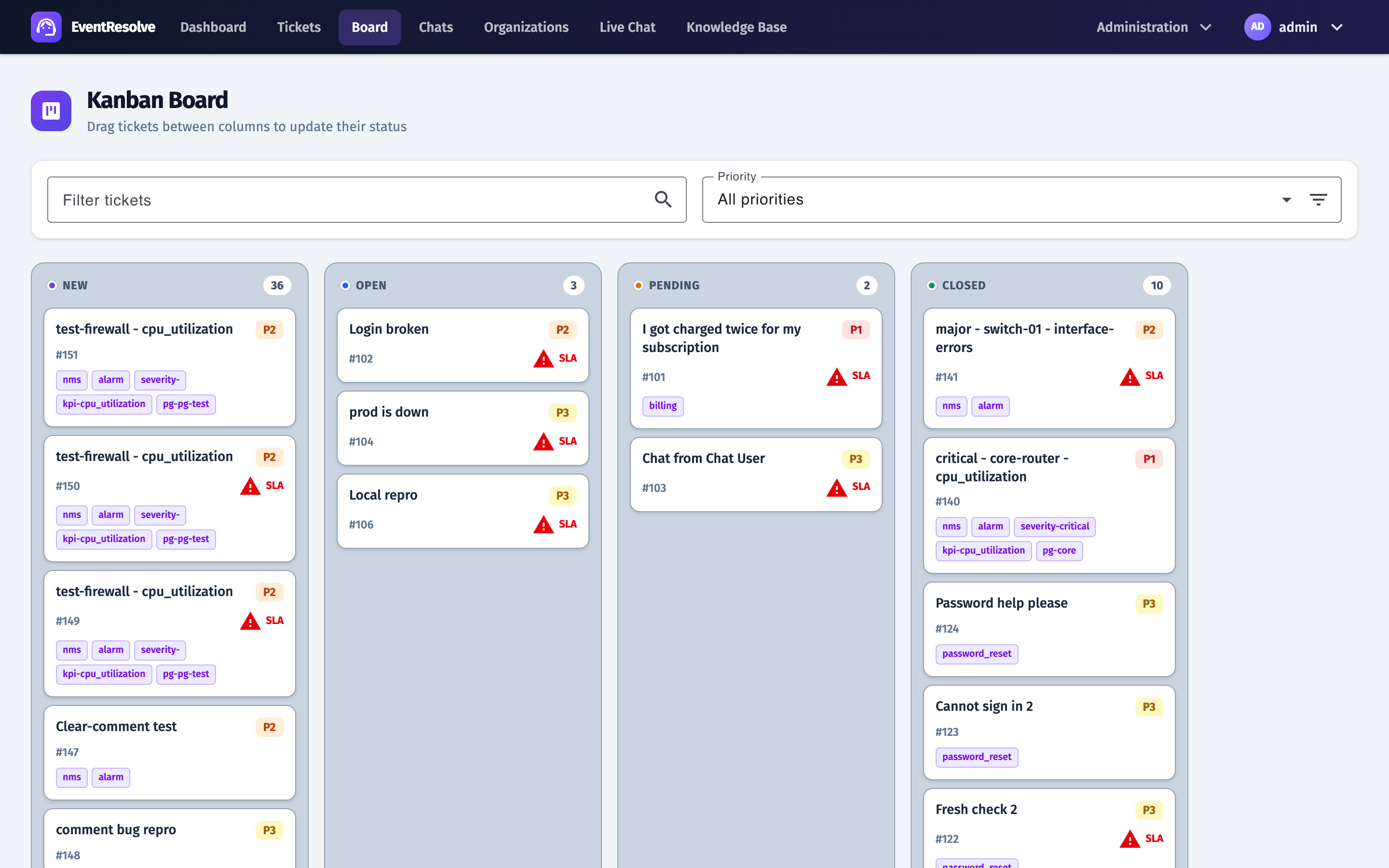
What makes EventResolve different
One inbox. Every channel.
Email, web forms, live chat, Slack, and REST API — every channel feeds one ticket stream. No tab-switching. No dropped conversations.
OmnichannelReal-time, not refresh
Server-Sent Events push every change — new tickets, comments, status moves — instantly to every open screen. Kanban, SLA counters, and activity feeds update themselves.
LiveAutomation that actually acts
A visual trigger engine fires on every ticket event with multi-criteria AND/OR logic. Bundle multi-step actions into one-click macros — triage happens before a human looks.
No-codeYour data never leaves. Ever.
Ticket summarization and reply drafting run against a self-hosted Ollama model — fully on-premises. Agents get instant context and polished drafts with zero external API calls.
Privacy-first AISLA deadlines stamped on the ticket
Per-priority response and resolution deadlines are stamped on every ticket. Overdue tickets flip an escalated flag that surfaces on dashboards and automation rules. Breaches never hide.
EscalationSmart email routing
Inbound mail is thread-matched by Message-ID with UIDVALIDITY-aware polling — no duplicates, no rescans. An admin-authored, sandboxed JavaScript hook can reroute, discard, or force-append any email.
ScriptableCustomer context, built in
Group customers by company, share tickets within a team, and flag users or entire orgs as VIP — crowns appear everywhere, and automation can match on VIP status.
OrganizationsKnowledge without leakage
Internal vs. public articles with strict scoping — internal content is never reachable by a customer through any path. Auto-suggest finds the right article while agents type.
ScopedRole-aware dashboards
6 KPI tiles for agents, 6 for customers — with live metrics, activity feed, quick actions, and drag-to-rearrange layout that persists per browser.
Per-role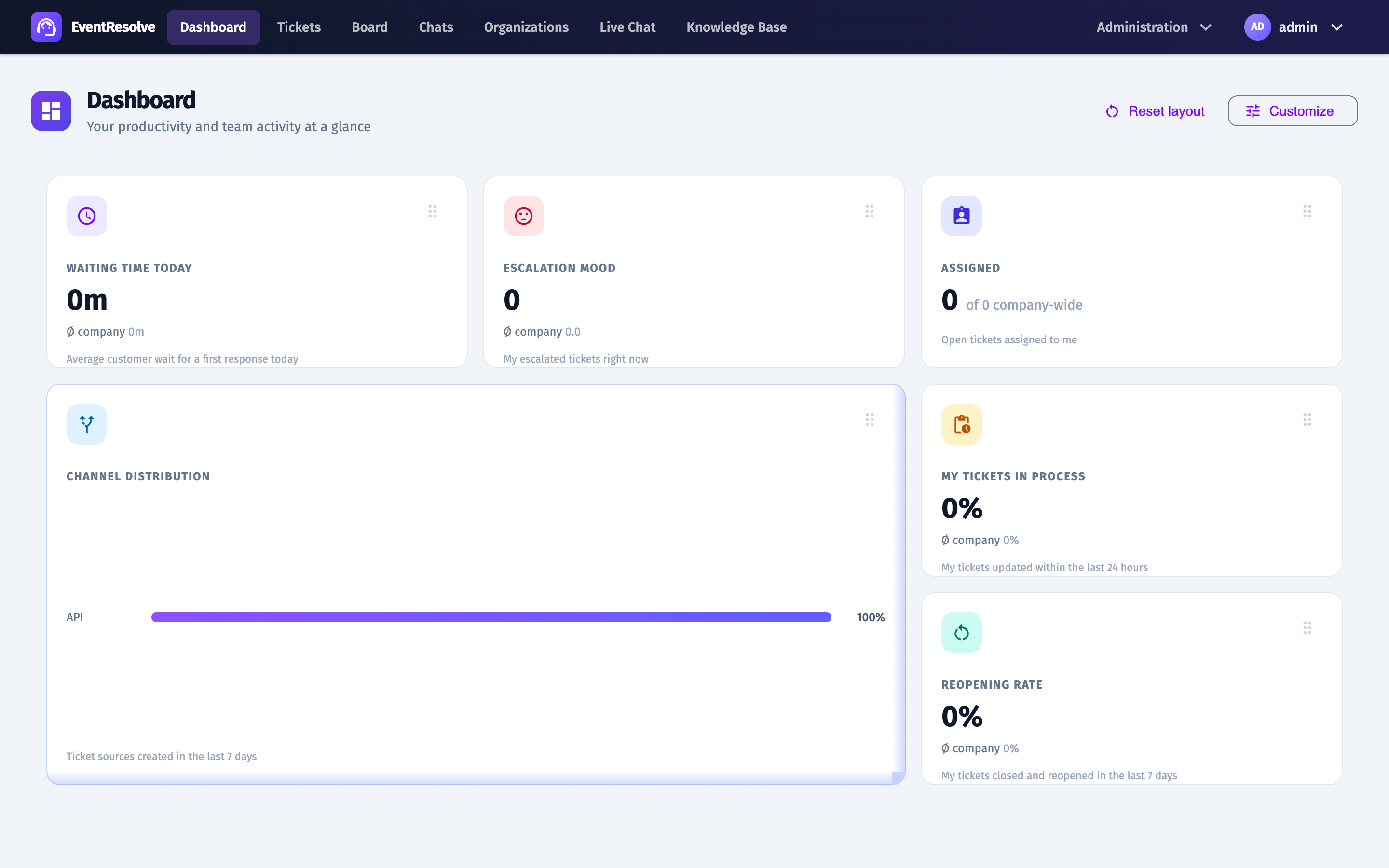
Self-contained. Reactive. On-prem.
No runtime internet dependency. No bolt-on caches. One JAR, one datastore.
-
One Spring Boot JAR
Java 25 + WebFlux non-blocking stack. Drop it in, it runs.
-
NoSQL data lakes
A single persistence layer. No JPA. No redundant caches.
-
Bundled & offline
Fonts, icons, AI models — all local. Runs air-gapped.
What operators report
"EventResolve reduced our average first-response time from 4 hours to 45 minutes. Our agents finally have a tool that works as fast as they do."
"The AI summarization feature is a game-changer. I can catch up on any ticket in seconds."
Deploy it before lunch.
Quick setup with Docker Compose. Fully documented REST API. Enterprise support available.
Privacy Policy
Last updated: 8 September 2025
EventSuite (comprising EventHorizon and EventResolve) is committed to protecting your privacy. This policy explains how we collect, use, and safeguard your personal data when you visit our website or use our services.
01Information We Collect
- Contact Information: Name, email address, phone number, and company name when you fill out our contact form.
- Usage Data: Pages visited, time spent, and referring URLs via standard web analytics (we use privacy-preserving analytics).
- Cookies: We use essential cookies for functionality. No third-party tracking cookies are used without explicit consent.
- Service Data: When you use EventHorizon or EventResolve, we process network topology, incident data, and configuration – all of which remain entirely within your infrastructure.
02How We Use Your Information
- To respond to your inquiries and provide product demonstrations.
- To send you technical updates, security alerts, and service notifications.
- To improve our website and service offerings based on usage patterns.
- To comply with legal obligations and enforce our terms of service.
03Data Sharing & Subprocessors
We do not sell your personal data. We may share data with:
- Email delivery services: To send you responses and updates.
- Hosting providers: For secure infrastructure.
- Legal authorities: When required by law.
All subprocessors are contractually bound to comply with GDPR/CCPA standards.
04Privacy-First AI
Our AI features (e.g., ticket summarization, draft improvement, alarm analysis) leverage local Ollama models running inside your network. No customer data, network topology, incident details, or personally identifiable information ever leaves your infrastructure or is used to train external models.
05Data Retention & Security
- We retain contact information for as long as we have an active business relationship.
- You may request deletion of your data at any time (see Section 06).
- We implement industry-standard encryption (TLS 1.3) for all data in transit and restrict access to authorized personnel only.
06Your Rights (GDPR / CCPA)
You have the right to:
- Access – Request a copy of your personal data.
- Rectify – Correct any inaccurate or incomplete data.
- Erase – Request deletion of your data.
- Restrict / Object – Limit or opt-out of processing.
- Portability – Receive your data in a structured format.
To exercise any of these rights, contact us at info@asia.infosim.net.
07Cookies
We use essential cookies for session management and security. We do not use tracking cookies without your explicit consent. You can manage cookie preferences in your browser settings.
08Updates to This Policy
We may update this policy periodically. The "Last updated" date at the top of this page will reflect any changes. We encourage you to review it regularly.
09Contact Us
EventSuite
Email: info@asia.infosim.net
Web: www.eventhorizon.com.sg
Terms of Service
Last updated: 8 September 2025
These Terms of Service ("Terms") govern your use of the EventSuite website, documentation, and related services provided by InfoSIM. By accessing or using our website or services, you agree to be bound by these Terms.
01Acceptance of Terms
By using this website or any of our products (EventHorizon or EventResolve), you agree to comply with and be legally bound by these Terms. If you do not agree, please do not use our services.
02Description of Services
EventSuite is a unified network operations platform comprising:
- EventHorizon: Service assurance, automation, and inventory management.
- EventResolve: ITSM, service desk, and incident response platform.
All services are provided "as-is" with a commitment to professional support and continuous improvement.
03Intellectual Property
- All software, source code, documentation, logos, and trademarks displayed on this site are the exclusive property of InfoSIM and its licensors.
- You may not modify, reverse engineer, redistribute, or create derivative works from our software without explicit written permission.
- EventHorizon, EventResolve, and EventSuite are trademarks of InfoSIM.
04User Responsibilities
- You are responsible for maintaining the confidentiality of your credentials and access keys.
- You agree to use our services only for lawful purposes and in compliance with all applicable laws and regulations.
- You shall not attempt to gain unauthorized access to our systems, networks, or data.
- You shall not use our services to distribute malware, spam, or any harmful content.
05Service Availability & Support
We strive to maintain high availability of our website and services. However, we do not guarantee uninterrupted access and may perform scheduled maintenance with reasonable notice. Support is provided during business hours (Singapore time) via email at info@asia.infosim.net.
06Data Privacy & Security
Our handling of your personal and operational data is governed by our Privacy Policy. We implement enterprise-grade encryption and access controls to protect your data. Our AI features process data locally (on-premise) – no sensitive data is transmitted to external cloud services.
07Fees & Payment
For commercial deployments of EventHorizon or EventResolve, a separate license agreement applies. This website provides informational access only; no software is distributed or licensed directly via this website without a formal agreement.
08Limitation of Liability
To the maximum extent permitted by law, InfoSIM and its affiliates shall not be liable for any indirect, incidental, special, consequential, or punitive damages, including without limitation loss of profits, data, use, goodwill, or other intangible losses, arising out of or in connection with your use of the website or services, even if advised of the possibility of such damages. Our total cumulative liability shall not exceed the amount paid by you (if any) for the services in the preceding 12 months.
09Disclaimer of Warranties
The website and services are provided "AS IS" and "AS AVAILABLE", without any warranties of any kind, either express or implied, including but not limited to warranties of merchantability, fitness for a particular purpose, or non-infringement. We do not warrant that the services will be error-free, secure, or uninterrupted.
10Indemnification
You agree to indemnify, defend, and hold harmless InfoSIM, its officers, directors, employees, and agents from any claims, liabilities, damages, losses, or expenses arising out of your use of the services, your violation of these Terms, or your infringement of any third-party rights.
11Governing Law
These Terms shall be governed by and construed in accordance with the laws of the Republic of Singapore, without regard to its conflict of law provisions. Any disputes shall be subject to the exclusive jurisdiction of the courts of Singapore.
12Modifications to Terms
We reserve the right to modify these Terms at any time. We will notify you of significant changes by posting an update on this page. Your continued use of the services after any changes constitutes your acceptance of the new Terms.
13Termination
We may suspend or terminate your access to the website and services at our sole discretion, without prior notice, if you violate these Terms or engage in conduct that we deem harmful to our operations or other users.
Book a walkthrough
Tell us about your network — device count, protocols in use, what your current stack misses. We'll run EventHorizon against your own telemetry, not a canned demo tenant.